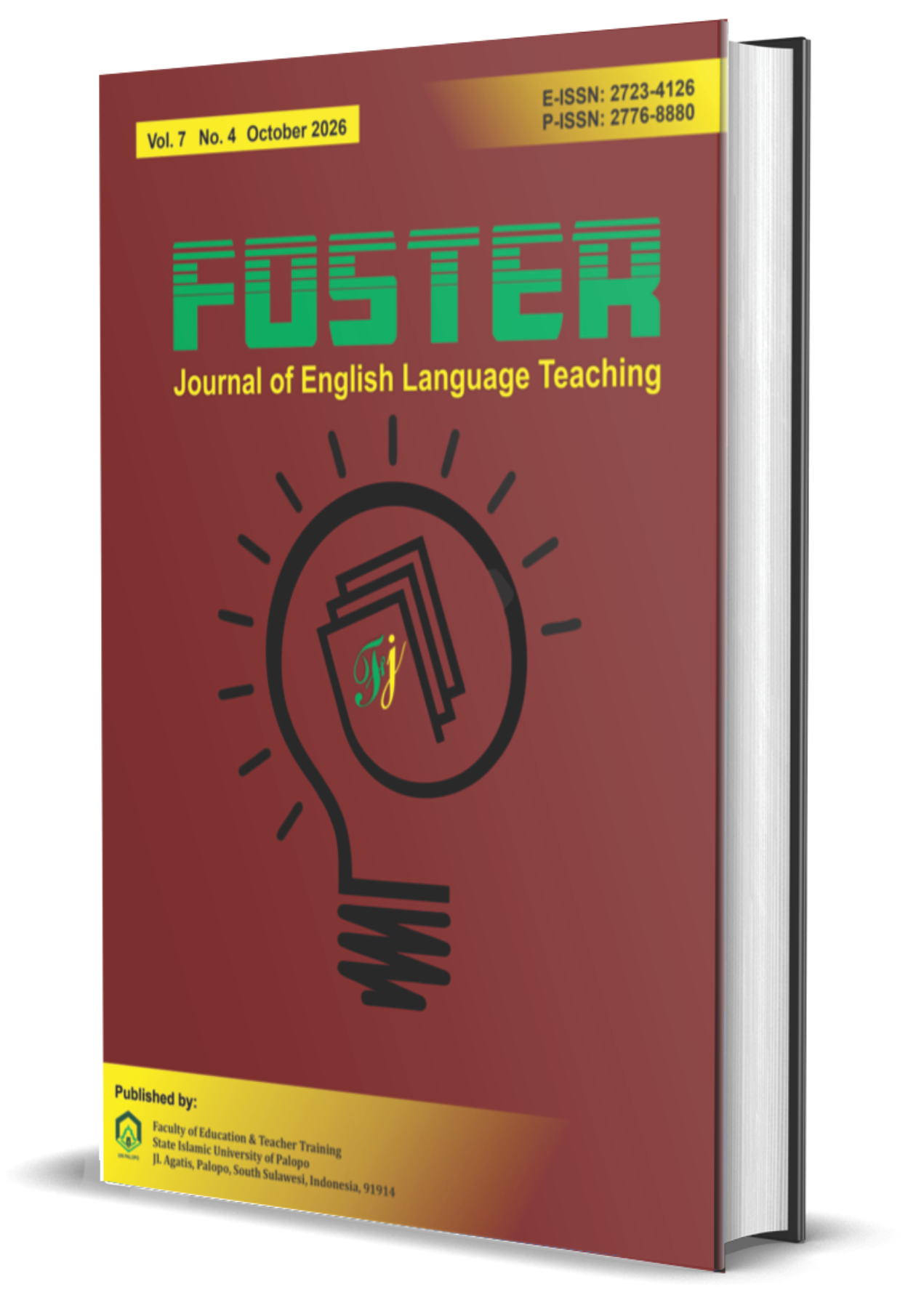
Listening Metacognition: Exploring EFL Students’ Listening Strategies through Retrospective Reflective Verbal Reports
DOI:
https://doi.org/10.24256/foster-jelt.v7i4.476Keywords:
EFL Learners, Listening Comprehension, Listening Metacognition, Metacognitive Strategies, Reflective Think-AloudAbstract
Listening assessment in EFL classrooms often focuses on final comprehension scores while giving limited attention to students’ thinking processes during listening activities. Therefore, this study aimed to explore students’ metacognitive listening strategies through reflective think-aloud protocols. This study employed a qualitative descriptive design involving 21 students from the Critical Listening class in the English Education Study Program selected through purposive sampling. Data were collected through retrospective reflective verbal reports recorded by students after completing their classroom listening tasks. The data were analyzed thematically using the metacognitive framework of planning, monitoring, and evaluating. The findings revealed that students employed various metacognitive strategies during listening activities. In the planning stage, students prepared themselves by reading instructions, predicting topics, and preparing supporting tools before listening. During the monitoring stage, students actively regulated their comprehension by replaying audio, focusing on keywords, taking notes, and guessing meaning from context. Monitoring strategies appeared as the most dominant process, indicating that students relied heavily on real-time strategy regulation to overcome listening difficulties such as fast speech, unfamiliar vocabulary, and different accents. In the evaluating stage, students reflected on their comprehension and identified the effectiveness of the strategies they used. The findings suggest that reflective think-aloud protocols can reveal learners’ metacognitive regulation more deeply than conventional score-based listening assessment. This study contributes to EFL listening research by demonstrating how reflective verbal reports can provide insights into learners reported metacognitive strategies and listening difficulties beyond conventional comprehension scores.
References
Arabi Zanjani, S. B., Tasnimi, M., & Azad, M. (2024). Developing and validating a listening mindset questionnaire through Think-Aloud Protocol. The Iranian Journal of Neurodevelopmental Disorders, 3(3). https://doi.org/10.61838/kman.jndd.3.3.11
Braun, V., & Clarke, V. (2021). (2021). Thematic analysis. Analysing qualitative data in psychology. London: Sage Publications Ltd, 128-47.
Bulut, B., & Ertem, ?. S. (2018). A Think-Aloud Study: Listening Comprehension Strategies Used by Primary School Students. Journal of Education and Training Studies, 6(5). https://doi.org/10.11114/jets.v6i5.3050
Chero, C. A. C. (2023). The Impact of Metacognitive Instruction on EFL Low-level Learners’ Listening Performance and Metacognitive Awareness. International Journal of Instruction, 16(2). https://doi.org/10.29333/iji.2023.16217a
Cresswell, J. D. (2018). Research design: Qualitative, quantitative, and mixed methods approaches (5th ed.). In SAGE Publications.
Flavell, J. H. (1979). 52.Metacognition and Monitoring (Flavell 1979). American Psychologist, 34(10).
Fu, Y., Wang, M., Min, S., Zhou, S., & Pan, X. (2023). Exploring the relationship between metacognitive awareness and Chinese EFL learners’ listening skills. Frontiers in Psychology, 14. https://doi.org/10.3389/fpsyg.2023.1148610
Goh, C. C. M., & Vandergrift, L. (2021). Teaching and learning second language listening: Metacognition in action. In Teaching and Learning Second Language Listening: Metacognition in Action. https://doi.org/10.4324/9780429287749
Graham, S., & Santos, D. (2015). Strategies for second language listening: Current scenarios and improved pedagogy. In Strategies for Second Language Listening: Current Scenarios and Improved Pedagogy. https://doi.org/10.1057/9781137410528
Hantuwa, W., Irawati, W. O., & Meiarni, I. (2025). Hambatan Dan Faktor-Faktor Dalam Proses Menyimak Serta Upaya Mengatasinya. Jurnal Pendidikan Merdeka Belajar, 2(2), 49–60.
Huang, L., & Wang, D. (2023). Teacher Support, Academic Self-Efficacy, Student Engagement, and Academic Achievement in Emergency Online Learning. Behavioral Sciences, 13(9). https://doi.org/10.3390/bs13090704
Panadero, E. (2017). A review of self-regulated learning: Six models and four directions for research. In Frontiers in Psychology (Vol. 8, Number APR). https://doi.org/10.3389/fpsyg.2017.00422
Rukthong, A., & Brunfaut, T. (2020). Is anybody listening? The nature of second language listening in integrated listening-to-summarize tasks. Language Testing, 37(1). https://doi.org/10.1177/0265532219871470
Schunk, D. H., & Greene, J. A. (2017). Handbook of Self-Regulation of Learning and Performance, Second Edition. In Handbook of Self-Regulation of Learning and Performance, Second Edition. https://doi.org/10.4324/9781315697048
Sulistyowati, T., Mujiyanto, J., Rukmini, D., & Hartono, R. (2022). Strategy Metacognisi pada Pembelajaran Kelas Menyimak untuk Mempersiapkan Siswa Sebagai Pembelajar yang Mandiri. Prosiding Seminar Nasional Pascasarjana, 2022.
Tang, K., Noordin, N., & Ismail, L. (2025). Evaluating the think-aloud method for English reading: a systematic review. In Cogent Education (Vol. 12, Number 1). https://doi.org/10.1080/2331186X.2025.2497150
Wakhidah, R., Maftuh, Moh. F., & Maaliah, E. (2019). Pengembangan Aplikasi Listening Test Berbasis Android. Journal of Applied Informatics and Computing, 3(2). https://doi.org/10.30871/jaic.v3i2.1181
Wang, Y., & Treffers-Daller, J. (2017). Explaining listening comprehension among L2 learners of English: The contribution of general language proficiency, vocabulary knowledge and metacognitive awareness. System, 65. https://doi.org/10.1016/j.system.2016.12.013
Yefridelti, Y. (2018). Improving Student Listening Ability Through Audio-Visual Application At Smpn 2 Painan. Jurnal Ilmiah Pendidikan Scholastic, 2(2). https://doi.org/10.36057/jips.v2i2.271
Zimmerman, B. J. (2017). Becoming a Self-Regulated Learner: An Overview Changing Conceptions of Individual Differences. Online) Journal, homepage, 1543–421. http://www.tandfonline.com/action/journalInformation?journalCode=htip20%0Ahttp://www.tandfonline.com/loi/htip20%0Ahttp://dx.doi.org/10.1207/s15430421tip4102_2
Downloads
Published
How to Cite
Issue
Section
License
Copyright (c) 2026 Rezki Nurhidayah Muchtar, La Sunra, Muh. Tahir

This work is licensed under a Creative Commons Attribution 4.0 International License.
In submitting the manuscript to the FOSTER: Journal of English Language Teaching, the authors certify that:
- They are authorized by their co-authors to enter into these arrangements.
- The work described has not been formally published before, except in the form of an abstract or as part of a published lecture, review, thesis, or overlay journal.
- That it is not under consideration for publication elsewhere,
- The publication has been approved by the author(s) and by responsible authorities – tacitly or explicitly – of the institutes where the work has been carried out.
- They secure the right to reproduce any material that has already been published or copyrighted elsewhere.
- They agree to the following license and copyright agreement.
License and Copyright Agreement
Authors who publish with FOSTER: Journal of English Language Teaching agree to the following terms:
- Authors retain copyright and grant the FOSTER: Journal of English Language Teaching right of first publication with the work simultaneously licensed under Creative Commons Attribution License (CC BY 4.0) that allows others to share the work with an acknowledgement of the work's authorship and initial publication in this journal.
- Authors can enter into separate, additional contractual arrangements for the non-exclusive distribution of the FOSTER: Journal of English Language Teaching published version of the work (e.g., post it to an institutional repository or edit it in a book), with an acknowledgement of its initial publication in this journal.
- Authors are permitted and encouraged to post their work online (e.g., in institutional repositories or on their website) before and during the submission process, as it can lead to productive exchanges, as well as earlier and greater citation of published work.